
Rebranding | Definition, Strategy, Process, & Examples
Rebranding is the strategic process of changing how a brand is perceived by its audience. It involves redefining a company’s identity, positioning, and communication in order to better align with business goals, market conditions, or customer expectations.
This article is a complete guide to rebranding: what it is, why it matters, the different types, how to rebrand, rebranding examples, and more. If you have a specific question about rebranding, ask QuillBot’s AI Chat.


What is rebranding?
Rebranding is a marketing strategy that aims to develop a new, differentiated brand identity. Rebranding seeks to change how the brand is perceived by consumers, competitors, investors, stakeholders, and employees.
Rebranding can affect many brand elements, like a company’s name, logo, visual identity, tone of voice, messaging, products, and even internal culture. While rebranding is typically associated with visual changes, the core of rebranding is strategic, not cosmetic. For example, a logo change without a shift in positioning or value proposition is not a true rebrand.
Like all branding practices, rebranding depends heavily on an organization’s target audience. In practice, rebranding is used to correct misalignment between what a company is and how it is perceived.
Why companies rebrand
The reasons for rebranding are usually driven by structural changes or strategic shifts. In most cases, companies rebrand because their existing brand no longer reflects their strategic reality. These are seven of the most common motivations for rebranding:
- Strategic growth
- Changing focus
- Targeting new audiences
- Competitive differentiation
- Reputation management
- Clarifying brand messaging
- Visual identity update
Strategic growth
Strategic growth is one of the primary reasons companies rebrand. As organizations scale, their original brand may no longer reflect their size, ambition, or scope of operations.
Rebranding for strategic growth often occurs when a company:
- Merges with another company
- Acquires or is acquired by another company
- Transitions from startup to enterprise
- Expands into international markets
These situations usually require a new brand identity to reflect the updated business structure, and in these situations, rebranding helps communicate maturity, credibility, and long-term vision. In cases of globalization, rebranding should take localization into account to make sure the brand identity resonates with all customers regardless of country of origin.
Changing focus
Some rebrandings happen because a company’s core focus changes. This may involve adopting a new business model, shifting priorities, or redefining mission and values.
Examples of changing focus include:
- Changing out legacy offerings for newer products or services
- Replacing physical products with digital services
- Shifting from generalist to specialist positioning
- Moving from a budget to premium offering
Rebranding due to a new focus makes sure that the brand reflects what the company actually does now, not what it did in the past. This type of rebranding should include careful review of the brand purpose statement to make sure it captures the brand’s new focus.
Targeting new audiences
Targeting new audiences is a common reason for rebranding, especially when existing brand identity does not resonate with the desired market.
This type of rebranding is often used to:
- Appeal to younger or older customers
- Reach a new demographic
- Enter international markets
- Break into different professional sectors
Rebranding in this context helps align the brand’s image with the new audience. This type of rebranding focuses heavily on messaging, tone of voice, brand personality, and cultural relevance.
Competitive differentiation
In highly competitive markets, many products and services become functionally similar. When features and pricing converge, customers find it difficult to distinguish between competitors, and brand perception becomes a key decision factor.
Rebranding for competitive differentiation is used when a company struggles to stand out, feels interchangeable with competitors, or competes in a saturated category. Rather than changing what the company offers, the goal is to change how it is perceived.
When rebranding for this reason, the goal is to:
- Clarify brand personality
- Shift brand positioning
- Establish a unique market position
- Communicate differentiating values or philosophy
The goal is perceived uniqueness, not novelty. Effective differentiation does not require being radically different. Instead, focus on being meaningfully distinct in ways that matter to the target audience.
Reputation management
Brand identity is directly linked to brand reputation. How the public perceives a brand—positively or negatively—shapes its credibility, trustworthiness, and ultimately its business performance.
When a brand’s reputation deteriorates, rebranding may be necessary. Companies often attempt to distance themselves from negative associations caused by scandals, legal issues, ethical failures, or prolonged customer dissatisfaction
Rebranding to improve a brand’s reputation generally seeks to:
- Restore trust
- Signal organizational change
- Reframe public perception in a positive light
Rebranding for reputation management is inherently reactive rather than proactive. It should therefore position the fresh start as a response to the factors that caused reputational damage in the first place. However, without genuine operational improvement, reputation-based rebranding rarely succeeds and may even reinforce public skepticism.
Clarifying brand messaging
As companies evolve, their messaging can become inconsistent, fragmented, or diluted. This is especially common in fast-growing organizations with multiple products, teams, or communication channels. Rebranding can help create a clear, cohesive, unified brand identity.
Rebranding to clarify brand messaging focuses on:
- Simplifying value propositions
- Standardizing tone of voice
- Aligning internal and external communication
- Setting strict guidelines for visual identity
The objective is coherence and consistency: making sure the brand communicates a single, clear identity across all touchpoints. Brand guidelines are essential here, as they explain exactly how diverse teams should—and shouldn’t—use brand assets, instead of each person making an individual judgment.
Visual identity update
Some rebrands are driven primarily by the need to update visual identity. Over time, design systems can become outdated or incompatible with modern platforms.
Visual identity updates typically include:
- Redesigning logos
- Refreshing color palettes
- Updating typography and imagery
- Aligning digital interfaces with contemporary standards
- Revising the layout or design of physical locations
This form of rebranding is the most visible, but it will not “stick” without strategic intent. A modernized visual system alone cannot compensate for outdated processes, poor customer experience, or old-fashioned corporate policies. Without aligning these operational and strategic elements, consumers are likely to perceive the rebrand as a superficial makeover.
Types of rebranding
Rebranding isn’t a one-size-fits-all strategy. Understanding the different types of rebranding helps companies choose the approach that best aligns with their objectives, resources, and market context.
| Type | Scope and focus | Key elements | Best for |
| Partial | Updates specific elements while keeping core identity intact | Logo refresh, updated color palette or typography, messaging and tone adjustments | Modernization; low-risk improvements |
| Full or Overhaul | Comprehensive overhaul of identity, positioning, and perception | New positioning, complete visual identity redesign, updated messaging and tone, sometimes new name | Major structural or strategic changes; high-impact transformation |
| Refresh or Facelift | Focuses exclusively on design elements | Logo redesign, color palette refresh, typography updates, digital interface adjustments | Modernizing appearance (must be paired with strategy to be effective) |
| Repositioning | Changes market perception without altering core identity | Targeting new audiences, highlighting unique value proposition, adjusting messaging and tone | Shift audience perception; clarify differentiation; respond to evolving market opportunities |
| Corporate | Organization-wide, affecting culture, messaging, and all products/services | Corporate identity overhaul, unified messaging, strategic alignment | Mergers, acquisitions, or major strategic pivots |
| Product | Focused on a single product, line, or service | Product-specific messaging, visual identity, or positioning changes | Repositioning individual offerings without affecting the broader corporate brand |
Before deciding whether to pursue a visual update, repositioning, or full transformation, brands should assess how well their current identity resonates with their target audience: does the brand communicate a clear and meaningful story, and does it still reflect how customers perceive its value?
The goal of rebranding is not to appear new. It’s to become more relevant, distinctive, and aligned with business objectives. Selecting the appropriate type ensures the rebrand is effective, strategically grounded, and capable of delivering lasting impact rather than short-term attention.
Rebranding process
The rebranding process requires careful planning, coordination, and execution. While the exact steps may vary depending on the type of rebrand, most successful initiatives follow an approach similar to the seven steps outlined below.
1. Identify the opportunity
Rebranding should start by clearly identifying the business problem or opportunity the brand needs to address. Is it a merger? New target audience? Outdated image? Naming this opportunity helps the rebranding lead with strategic necessity rather than surface-level dissatisfaction.
Write a short brief that answers:
- What problem will the rebrand solve?
- What needs to change?
- What shouldn’t change?
- Who’s the target audience now?
- How will you measure the success of the rebrand?
Generally, teams are more successful when they document their strategy and set up a clear way to measure its success from the start. If you can’t think of a way to track the effects of your rebrand, maybe the reason for rebranding isn’t clear.
- In-house rebranding: Teams usually have deeper insight into company culture, internal processes, and history. However, they may require additional project management, coordination, and bandwidth to execute the rebrand effectively.
- Agency-led rebranding: Agencies bring objectivity, creative expertise, and execution capacity, but they may need more guidance on the company’s history, values, and internal context to ensure alignment.
Keep in mind that budgets and timelines can differ depending on who drives the rebrand. Internal teams might work more slowly but cost less, while agencies may deliver faster but require a larger upfront investment.
2. Audit the brand, market, and audience
Whether you’re an internal team or a third-party design firm, a comprehensive audit reveals how the brand is currently perceived and how it compares to competitors. This step provides the evidence for all strategic decisions going forward.
In this stage, you should review:
- Current visual identity, messaging, and tone of voice
- Customer feedback, sentiment, and engagement
- Pain points with the brand and misconceptions of it
- The words most often used to describe the brand
- Competitors benchmark and industry standards
- Visual and verbal gaps in the market you could potentially fill
Review surveys, product reviews, customer support tickets, internal and external interviews, and whatever other materials you can gather. Create a report or brief slide deck to gather your audit findings in one place. This document should become a cornerstone of your rebranding process.
3. Define brand strategy
Brand strategy sets the future direction of your brand and ensures that all creative decisions support real business goals. This is the most critical—and often the hardest—stage of the rebranding process, because it forces you to make deliberate choices about what should change and what should stay.
At this stage, you should define, not design. Visual identity comes after the strategy is clear, not before. Depending on your brand’s unique situation, you may need to:
- Redefine your mission, vision, values, brand promise, and/or positioning
- Clarify exactly who you help, what you offer, and why that matters
- Change your name, tagline, messaging pillars, tone of voice, and visual identity
Create core brand copy to help lock in your positioning, promise, and voice:
- Tagline: A short, memorable promise
- Brand story: A one-paragraph explanation of who you serve and how
- Key messages: Three to five proof points that support your positioning
4. Design the new brand identity system
A new brand identity system translates strategy into the tangible “look and feel” that customers interact with. During this stage, you may have to:
- Develop the visual system, including logo, color palette, and typography
- Redefine the verbal identity—brand voice and messaging frameworks
- Ensure adaptability and accessibility across digital and physical channels
That said, keep what works. As an example, if your brand’s colors still align with your brand purpose and are well-liked by your target audience, don’t change them. Only redesign what needs updating, and avoid change for change’s sake.
Below are some practical tips for different components of brand identity:
- Logo: Keep it simple, clear, and flexible. It should work at all sizes and in all contexts (e.g., business cards, TV advertisements, and product packaging).
- Color: Choose two to three colors max (one primary and two supporting). Be mindful of color theory and psychology when deciding which to use.
- Typography: One primary and one secondary font is more than enough. Set sizes, weights, and spacing rules to keep text consistent across channels and content.
- Imagery: Set clear rules and styles for photographs and/or illustrations. For example, you may decide to only use photographs with natural lighting and never studio lighting.
- Brand voice: What’s your brand personality? Think of people you know or fictional characters who have similar personalities. How do they speak? What feelings do they transmit?
Create brand guidelines that clearly document all the new elements of your brand. Brand guidelines should be the “one source of truth” for your rebranding. This way, everyone—from the CMO to a customer service intern—knows exactly how (and how not) to express your brand.
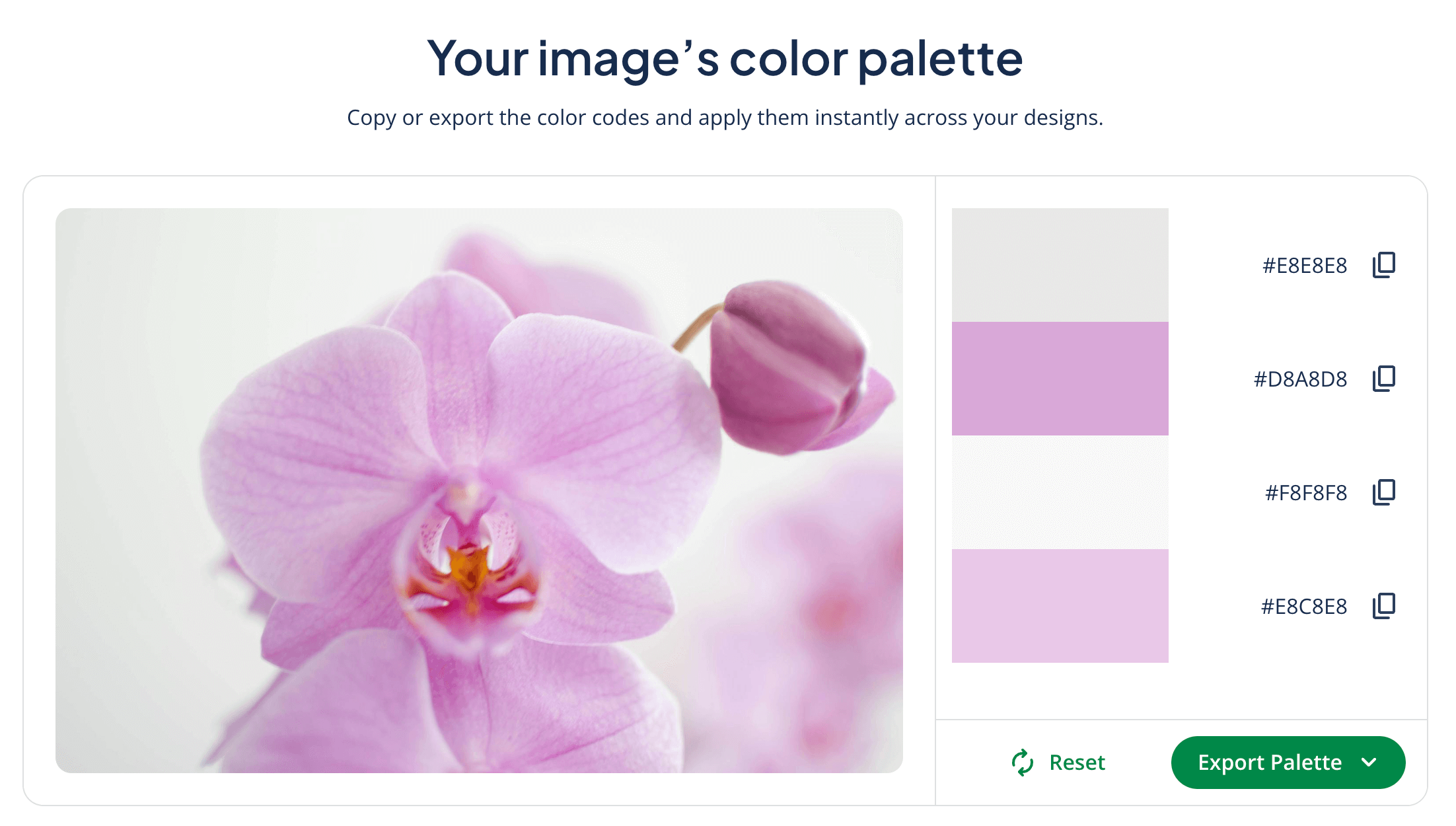
For example, this color palette was extracted from a photo of an orchid using the QuillBot color palette generator:
5. Roll out internally
Roll out the rebrand internally before going public. Internal alignment is critical for credibility and consistency, as employees are the first people who will represent the new brand to the outside world.
You should:
- Educate teams on the rationale behind the rebrand, not just the new identity
- Share updated brand guidelines, and voice and tone documentation
- Provide example scripts, FAQs, and use cases for common scenarios, such as customer support inquiries or sales conversations
Leave enough time for this step; employees may need training sessions, workshops, or hands-on practice to apply the new brand identity correctly. If you’re working with a distributed team, make sure materials are accessible asynchronously, and consider recorded presentations or internal hubs where staff can revisit resources as needed.
6. Launch externally
Plan the launch of your rebrand like a comprehensive marketing campaign. Decide on how to launch: everything at once or phased, with the most important channels changing first.
Prepare a realistic schedule and budget, and create a master document that tracks every asset that needs updating, along with deadlines and ownership. This prevents inconsistencies and sees that no customer-facing touchpoints are overlooked. You will likely need to update your:
- Website, including landing pages, blogs, e-commerce components, etc.
- Social media channels and profile assets
- Email newsletter headers, footers, and templates
- Employee email signatures, fonts, and colors
- Assets on external review sites (e.g., Trustpilot and G2)
- Signage, decor, and physical marketing materials
- Legal documents (e.g., terms of service, privacy policy, and cookies policy)
- SEO elements, like link redirects
When you rebrand, you’re not just changing a logo or a website—you’re changing every place where your brand appears. The goal is to make sure customers see the new brand everywhere at the same time, instead of a confusing mix of old and new.
7. Monitor and evaluate
Once your rebrand is live, you need to track how it performs and whether it’s actually achieving the goals you set at the strategy stage. Use analytics to track how rebranding affects brand awareness, reach, and sentiment.
Track impact for at least 60–120 days, focusing on both performance and perception, particularly the following metrics:
- Performance metrics
- Website traffic, bounce rate, and conversions
- Engagement on social media (e.g., follows, comments, shares)
- Brand search volume and direct traffic
- Sales or lead quality (depending on your business model)
- Perception and feedback
- Customer feedback via surveys, reviews, and support tickets
- Social listening (i.e., how people talk about your brand online)
- Internal feedback from sales, support, and marketing teams (e.g., customer support tickets related to confusion)
- Consistency and adoption
- Correct use of new branding and adherence to brand guidelines
- New materials and content aligned with brand guidelines
- Removal of old assets
Set regular review points (for example, after 30, 60, and 90 days). Use what you learn to make small adjustments to messaging, visuals, or tone of voice. Rebranding is not a one-off event; it’s a controlled change process that should keep improving based on real data, not assumptions.
Rebranding checklist
A rebranding checklist helps ensure that no critical steps are skipped and that the process stays aligned with strategic goals rather than drifting into purely visual changes. Use the checklist below as a high-level control tool before, during, and after your rebrand.
| Rebranding stage | What to check |
| Strategy and planning | Clear business reason for rebranding documented |
| Success metrics defined (brand, marketing, or business KPIs) | |
| Target audience clearly identified and researched | |
| Budget, timeline, and internal ownership assigned | |
| Brand strategy | Mission, vision, values reviewed or rewritten |
| Brand positioning and value proposition defined | |
| Brand story, tagline, and key messages finalized | |
| Brand voice and tone guidelines created | |
| Identity system | Logo tested across formats and sizes |
| Color palette and typography finalized | |
| Visual rules for imagery and layouts documented | |
| Accessibility and usability standards checked | |
| Internal rollout | Employees informed of the strategy behind the rebrand |
| Brand guidelines distributed and explained | |
| Training or onboarding sessions completed | |
| Internal tools and templates updated | |
| External rollout | Website and digital assets updated |
| Social media profiles refreshed | |
| Email templates and signatures updated | |
| Review platforms and directories updated | |
| Legal and compliance documents reviewed | |
| Post-launch | Performance metrics tracked |
| Customer sentiment monitored | |
| Old assets retired | |
| Quarterly brand review scheduled |
Rebranding examples
Studying examples, even fictional ones, can help clarify how different types of rebrands work in practice. Most rebrands fall into one of three categories: strategic repositioning, visual modernization, or reputation recovery.
Strategic repositioning occurs when a company changes how it competes or who it serves. These rebrands often include new messaging, positioning, and sometimes a name change.
- Context: Originally a B2C electronics brand focused on budget gadgets, LumaTech shifts to premium smart home systems targeting design-conscious professionals.
- Rebrand focus: New logo, refined color palette, updated messaging, and tagline emphasizing sophistication and control.
LumaTech uses AI to quickly generate this image—focusing on minimalism and quiet luxury—which it includes in its brief to its rebranding design team.

Visual modernization takes place when a brand’s strategy remains intact, but its visual system is outdated, inconsistent, or incompatible with modern platforms.
- Context: Café Verde has rustic, hand-drawn logos and inconsistent signage across locations. The brand retains its focus on organic, locally sourced coffee but modernizes its design for digital and print consistency.
- Rebrand focus: Updated logo, cohesive color palette, modern typography, social media graphics, and standardized packaging.
Café Verde’s branding design team generates mockups of one of the new logo proposals on a takeaway coffee cup to see how this branding could look in context.

Reputation recovery is used after public trust has been damaged. These rebrands aim to rebuild credibility and reframe perception.
- Context: Investigative reports revealed that some of ClearWave’s water sources were overexploited, and the company’s packaging was contributing significantly to plastic waste. Public backlash emerged online and in the media, with environmental groups and customers questioning the company’s ethics and transparency.
- Rebrand focus: To recover trust, ClearWave undertook a reputation-based rebrand emphasizing sustainability, responsible sourcing, and transparency. The rebrand includes new messaging around sustainability, an updated logo emphasizing purity, clear visual identity, eco-friendly packaging, and a PR campaign highlighting operational changes.
Before rebrand (voice & tagline):
- Tagline: “Pure taste, anytime, anywhere.”
- Voice: Functional and generic, focused on convenience and flavor.
After rebrand (voice & tagline):
- Tagline: “Transparent water. Trusted practices.”
- Voice: Honest, responsible, and reassuring, emphasizing sustainability and ethical sourcing.
Frequently asked questions about rebranding
- How do you rebrand yourself?
-
To rebrand yourself, you can more or less follow the guidance for rebranding companies, with some slight shifts in focus:
- Name the opportunity. What is it you want to change, and why?
- Audit your current brand—your profession, interests, network, communication style, and mindset. What feels like it’s no longer aligned with your goals and identity?
- Define your new strategy. Choose 3–5 words that define your future self to use as your guidepost going forward.
- Update your visual identity, including your CV, LinkedIn profile, portfolio, bio, and how you present yourself in meetings and interviews.
- Implement internally. Adjust your habits and behavior to match your new positioning—taking on different types of projects, developing new skills, changing how you communicate, or seeking out new professional circles.
- Communicate externally. Be consistent across all channels to build recognition and credibility.
- Monitor and iterate. Track feedback from friends, colleagues, and online interactions. Reflect regularly on whether your actions and presentation align with your desired identity, and make adjustments as needed.
To brainstorm more ways to rebrand yourself, ask QuillBot’s AI Chat.
- What’s the meaning of rebrand?
-
“Rebrand,” as a verb, means “to change or update a brand’s identity to alter how it is perceived by an audience” (e.g., “The company decided to rebrand once it went international”).
As a noun, “rebrand” means “the process or result of rebranding” (e.g., “Their rebrand included a new logo, tagline, and website design”).
Ask QuillBot’s AI Chat to learn about the meaning of “rebrand.”
Cite this QuillBot article
We encourage the use of reliable sources in all types of writing. You can copy and paste the citation or click the "Cite this article" button to automatically add it to our free Citation Generator.
Santoro, K. (2026, February 18). Rebranding | Definition, Strategy, Process, & Examples. Quillbot. Retrieved February 20, 2026, from https://quillbot.thesisseotools.com/blog/branding/rebranding/
